Post-process solver output into insight — slices, iso-surfaces, streamlines, glyphs, and derived fields.
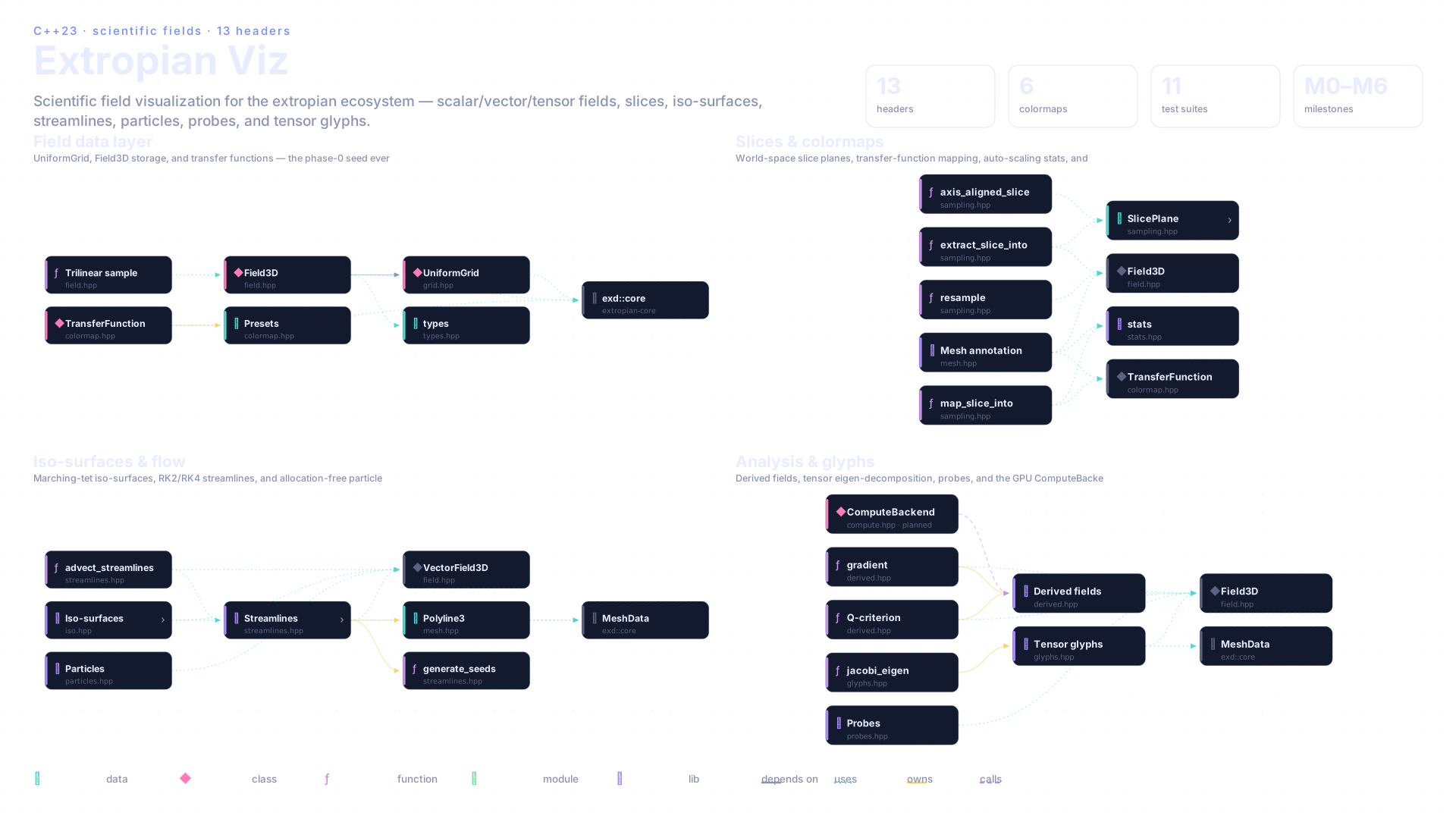
Dependency Graph
Solver output is only valuable when it can be seen, compared, and understood. Extropian Viz (exd::viz) is a generic scientific-field visualization library that consumes scalar/vector/tensor fields on uniform grids (UniformGrid, Field3D<T>) and produces the core post-processing and visualization techniques: slice planes with transfer-function colormapping, watertight iso-surfaces via marching tets, RK2/RK4 streamlines, particles, bounded-history point probes, tensor glyphs (Jacobi eigen-decomposition, fractional anisotropy), and derived fields (gradient, curl, divergence, vorticity, Q-criterion). Data maps onto existing geometry too — per-vertex field coloring, plane cross-sections, and iso-contour lines on meshes — without ever rewriting topology.
Architecturally it is interface-first and GPU-behind-the-interface: every algorithm ships as a deterministic CPU reference implementation with analytic headless tests, and a ComputeBackend interface is planned so GPU kernels (slice extraction, iso compaction, particle advection, resampling) can arrive without touching the public API. The library depends on exd::core only and never on a solver or renderer; solver outputs and product data are adapted into viz inputs by consuming repos.
The optional showcase demo walks every landed technique on an analytic Taylor–Green vortex rendered through Extropian Render, and the planned ECS layer publishes render outputs so a host render pipeline draws them without knowing viz exists.
Core capabilities
Slice planes + scientific colormaps (grayscale, hot, jet, viridis, inferno, cool_warm) with auto-scaling from percentile stats
Watertight iso-surfaces (marching tets), streamlines (RK2/RK4, deterministic seeds), and particles
Binary Distribution (Proprietary)Internal Use (Proprietary)
Licensing is negotiated around the software, deployment model, scope, and ownership requirements of each project — whether Extropian Viz is used as-is, customized for your workflows, or embedded in a larger system you are building. I prefer perpetual licenses per major version: one fee licenses the version you chose for as long as you use it, with maintenance updates included within that major version.
Binary Distribution (Proprietary): one-time license to use and distribute the software in binary form, including inside products you sell.
Internal Use (Proprietary): one-time license for ongoing internal use of the software as delivered — no distribution, no recurring fees.