One composable runtime — couple physics, not solvers.
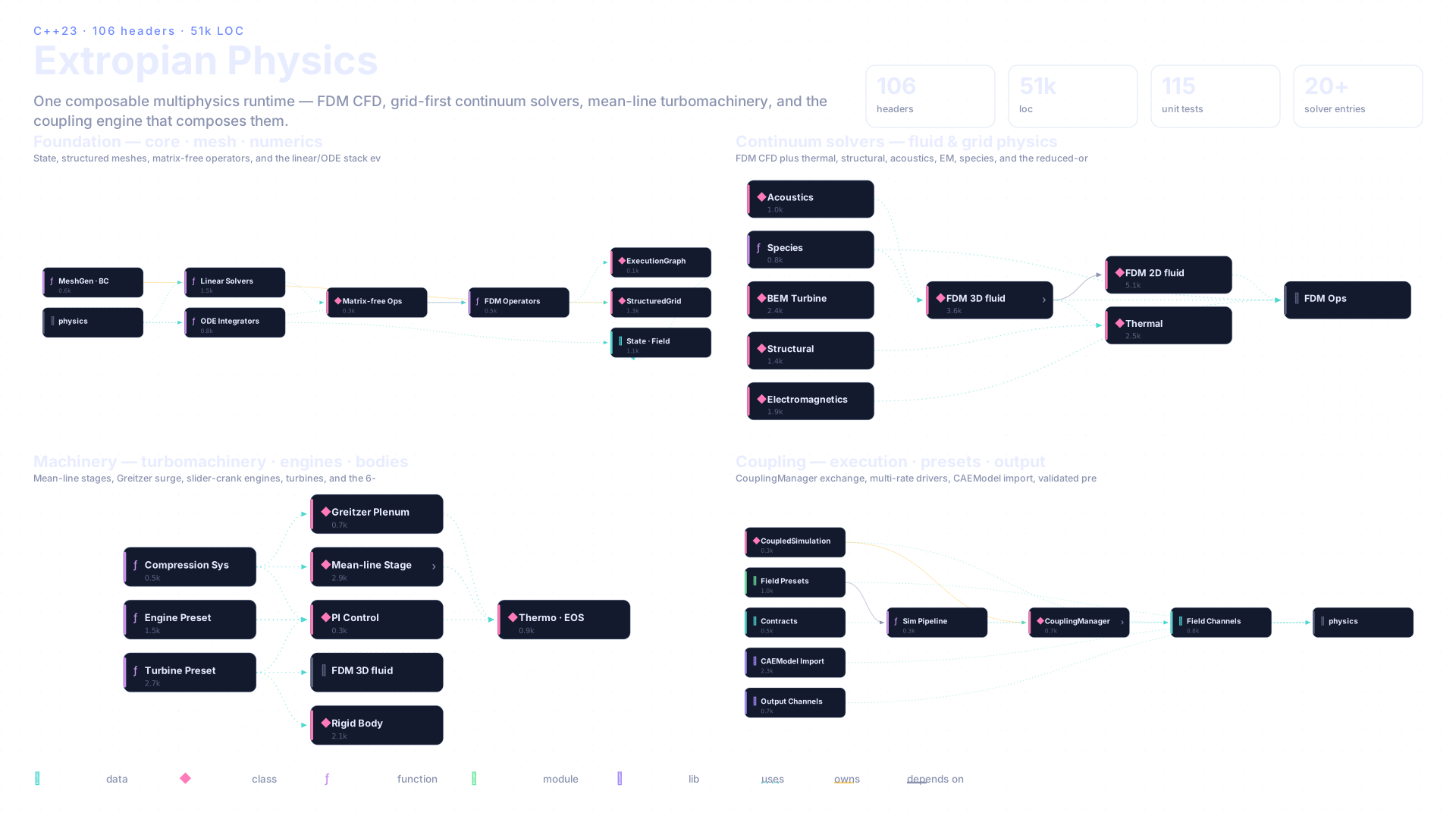
Dependency Graph
Extropian Physics is the numerical heart of the ecosystem: a single composable numerical engine, not a collection of monolithic solvers. It builds simulations from data + operators + physics + discretization + coupling + execution + hardware: physics modules declare mathematical requirements, a coupling engine links them over typed field channels with validated contracts (units, rank, conservation, temporal behavior), and presets assemble verified configurations — coupled wind/water turbines, Otto-cycle and steam engines, incompressible 3D FDM CFD, conjugate heat transfer, aeroacoustics, and more. It runs CPU today (parallel_for/reduce/stencil primitives) behind a hardware-independent design that targets a CUDA GPU backend.
The solver cores are real and analytic-verified: FDM stencil operators (gradient/divergence/curl/Laplacian/advection), matrix-free linear solvers (CG/GMRES/BiCGSTAB), eight ODE integrators, and grid-first domains including thermal, acoustics, linear elasticity, particles, chemistry, porous media, and species transport. Turbomachinery covers axial mean-line stages and stacks (compressor/turbine senses emerge from geometry), operating maps, and Greitzer surge dynamics. A deterministic import pipeline turns external CAE models into solver-ready meshes and materials; output streams binary field stamps and CSV machine-state series at a real-time cadence for visualization and optimization loops.
Because the engine is modular, an engagement rarely adopts it whole — more often a solver, a coupling strategy, or the execution layer becomes the starting point for a specialized application.
Core capabilities
Coupled multiphysics runs (FSI, conjugate heat transfer, thermal stress, joule heating, aeroacoustics, species-in-flow) via a validated coupling engine
FDM-based incompressible 3D CFD with immersed solids and Boussinesq natural convection
Grid-first solvers: thermal, structural elasticity, acoustics, particles, chemistry, porous media, electromagnetics, species transport
Axial mean-line turbomachinery (stages, operating maps, Greitzer surge) and reduced-order BEM turbines
Rotating-machine presets: coupled turbines, Otto-cycle combustion and Rankine-lite steam engines with governors and generator loads
Deterministic, batchable entry points with real-time field/CSV output channels
Binary Distribution (Proprietary)Internal Use (Proprietary)
Licensing is negotiated around the software, deployment model, scope, and ownership requirements of each project — whether Extropian Physics is used as-is, customized for your workflows, or embedded in a larger system you are building. I prefer perpetual licenses per major version: one fee licenses the version you chose for as long as you use it, with maintenance updates included within that major version.
Binary Distribution (Proprietary): one-time license to use and distribute the software in binary form, including inside products you sell.
Internal Use (Proprietary): one-time license for ongoing internal use of the software as delivered — no distribution, no recurring fees.